

The Hematology/Oncology Pharmacy Association (HOPA) has launched a collaborative network designed to help hematology/oncology pharmacists and other clinicians to more efficiently navigate complex practice challenges. This particular specialized educational service, called the Pharmacy Peer Network, connects clinicians with pharmacists who are experts in bispecific antibody therapies in a one-on-one setting.
A bispecific T-cell engager (BiTE) is engineered to treat cancer in a 2-pronged attack by targeting the cancer itself in 1 arm and by harnessing the body’s immune system in the other arm. As the use of bispecific antibodies continues to expand, healthcare teams are navigating new clinical, operational, financial, and educational challenges.
The Benefits of a Pharmacy Peer Network on BiTEs
According to Darren Luon, PharmD, BCOP, Clinical Pharmacy Specialist, Thoracic Oncology at Yale New Haven Hospital, and who served on the advisory group that conceptualized, designed, and launched this industry-supported network, “a peer network allows cancer centers that may be in the early stages of implementing BiTEs to reach out and connect with clinicians/administrators from other systems who have greater experience with these medications. This allows the requestor to have an individualized peer expert to walk them through the complex implementation of these therapies. These experts will have already worked through the same clinical, logistical, and operational challenges they are facing. Unlike a typical Q&A or forum post, this is a partnership that is designed to provide longitudinal support through every stage of the process. One of our hopes is that the peer experts will build confidence for clinicians at smaller institutions and reduce the hesitancy that can delay the adoption of BiTEs.”
Challenges Encountered With Adopting BiTEs
BiTEs are complex therapies that have a number of unique adverse events (AEs), most notably, cytokine release syndrome (CRS) and immune effector cell–associated neurotoxicity syndrome (ICANS).1,2 These AEs often require additional monitoring, which can include inpatient observation. In addition to the risk for these AEs, Dr Luon stated, “a significant challenge that clinicians encounter is patient access. Oftentimes BiTEs are only initiated in large academic medical centers that have the resources and experience to safely treat oncology patients. This leads to disparities in access to BiTEs for patients who live in rural areas—often several hours away from the nearest academic medical center.” Dr Luo added that “as new institutions are looking to use BiTEs and improve access to these powerful agents, institutions new to BiTE use will have to create workflows and protocols/pathways, enroll in Risk Evaluation and Mitigation Strategies (REMS) programs, and train their staff.”
Educational Needs for Staff: Management Strategies
To best manage patients receiving BiTEs, institutions should create standardized protocols for CRS and ICANS management to help guide interdisciplinary team members to be able to rapidly identify and treat patients when these AEs occur.1,2 Education related to the management of CRS and ICANS should be targeted toward internists, emergency medicine healthcare providers, nurses, and pharmacists.
CRS is the most common AE seen with the use of BiTEs, and symptoms include fever, fatigue, headache, low blood pressure, and shortness of breath. It is generally temporary and treatable with tocilizumab or steroids. Symptoms of ICANS include confusion, difficulty writing, tremors, or changes in speech, and are typically treated with antiseizure medication, tocilizumab, and steroids.
The Importance of Monitoring
Monitoring for ICANS typically includes the use of the ICE (immune effector cell encephalopathy) score to assess orientation, naming, attention, and writing; other important signs to monitor include level of consciousness, motor findings, seizure assessment, and intracranial pressure level or extent of cerebral edema.2 In addition, assessing the patient’s handwriting can be useful in detecting early fine-motor or cognitive changes in both ICANS and CRS.1 Monitoring for the onset of CRS also involves assessing the patient’s vital signs, oxygen saturation levels, and neurological status. A fever is often the first indicator of CRS.1
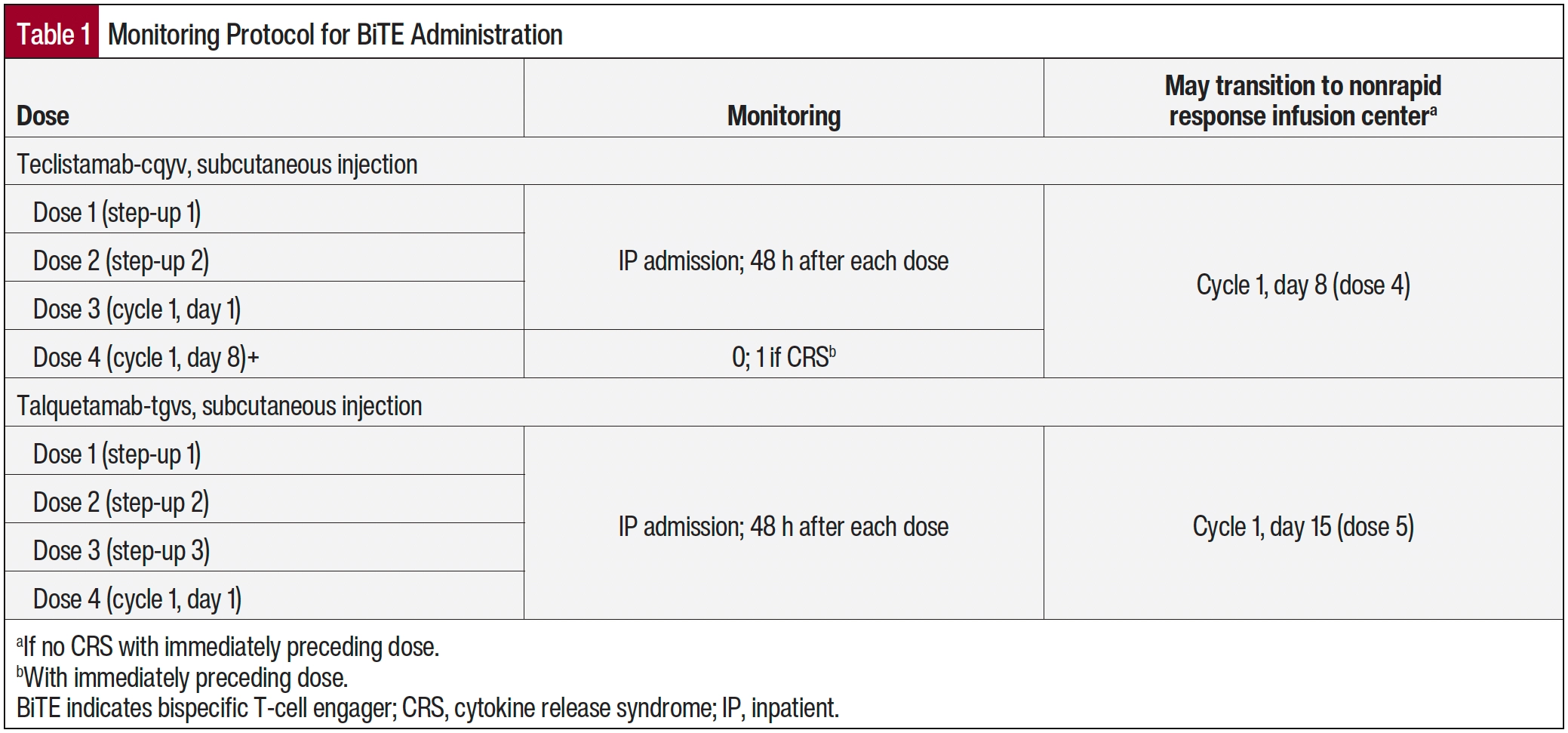
A recent study by Jiwani and colleagues described their experience in establishing a monitoring protocol across 13 infusion centers within their network, which included 12 community infusion centers, supported by comprehensive staff training and REMS enrollment (Table). The authors showed that with appropriate training and protocols, BiTE therapy can be used in community settings, expanding access to effective treatments and maintaining safety. In this study, the authors also were able to reduce the need for additional monitoring on discharge.3
To connect with the HOPA peer experts, please visit www.hoparx.org/resources/hopas-pharmacy-peer-network/.
References
- Brudno JN, Kochenderfer JN. Current understanding and management of CAR T cell-associated toxicities. Nat Rev Clin Oncol. 2024;21:501-521. doi:10.1038/s41571-024-00903-0
- Zhang B, Alder L, Rosner S, et al. A multi-institutional perspective on tarlatamab administration and management of CRS/ICANS. Lung Cancer. 2026;211:108870. doi: 10.1016/j.lungcan.2025.108870
- Jiwani R, Maples S, Rajarajan S, et al. Expanding bispecific T-cell engager therapy for multiple myeloma to community settings: a single-institution experience. J Hematol Oncol Pharm. 2026;16:1-8. Accessed July 20, 2026. www.jhoponline.com/issue-archive/2026-issues/december-2026-vol-16-no-6/expanding-bispecific-t-cell-engager-therapy-for-multiple-myeloma-to-community-settings