

Articles
The US Food and Drug Administration today approved Imlygic (talimogene laherparepvec), the first FDA approved oncolytic virus therapy, for the treatment of melanoma lesions in the skin and lymph nodes.
Today the US Food and Drug Administration (FDA) expanded the approved use of Yervoy (ipilimumab) to include a new use as adjuvant therapy for patients with stage III melanoma, to lower the risk that the melanoma will return following surgery.
The US Food and Drug Administration (FDA) today approved Onivyde (irinotecan liposome injection), in combination with fluorouracil and leucovorin, to treat patients with advanced (metastatic) pancreatic cancer who have been previously treated with gemcitabine-based chemotherapy.
The US Food and Drug Administration (FDA) today approved Yondelis (trabectedin), a chemotherapy, for the treatment of specific soft tissue sarcomas (STS)—liposarcoma and leiomyosarcoma—that cannot be removed by surgery (unresectable) or is advanced (metastatic).

There are numerous complications that may develop in patients with cancer; some are related to the disease itself, whereas others are associated with agents or combination regimens used during the course of treatment.

A nurse/patient navigator is defined by the Academy of Oncology Nurse & Patient Navigators as “a medical professional whose clinical expertise and training guides patients and their caregivers to make informed decisions, collaborating with a multidisciplinary team to allow for timely cancer screening, diagnosis, treatment, and increased supportive care across the cancer continuum.”
The US Food and Drug Administration (FDA) granted accelerated approval for Keytruda (pembrolizumab) to treat patients with advanced (metastatic) non–small-cell lung cancer (NSCLC) whose disease has progressed after other treatments, and with tumors that express a protein called PD-L1.
On September 30, 2015, the US Food and Drug Administration (FDA) granted accelerated approval to nivolumab (Opdivo Injection, Bristol-Myers Squibb Company) in combination with ipilimumab for the treatment of patients with BRAF V600 wild-type, unresectable or metastatic melanoma.

Rolapitant 180 mg significantly reduced symptoms of chemotherapy-induced nausea and vomiting in patients treated with multiple cycles of highly or moderately emetogenic chemotherapy when compared with placebo in 4 double-blind, active-controlled studies.
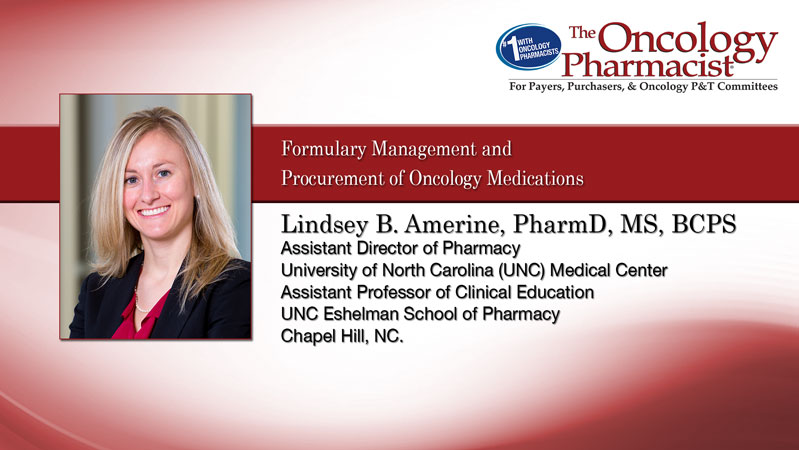
Lindsey B. Amerine, PharmD, MS, BCPS, discussed her practice’s process for formulary management and procurement of oncology medications at the 11th annual Hematology/Oncology Pharmacy Association conference.