

Joy Leonard, PharmD; Michael Goldenhorn, PharmD, MBA; Christopher Keeys, PharmD, BCPS; Sabeen Ali, PharmD
Background
Understanding adverse drug reactions (ADRs) and the application of pharmacovigilance are necessary to provide safe and effective patient care. Institutional policies at Sibley Memorial Hospital (SMH)-Johns Hopkins Medicine in Washington, DC, define ADRs as any undesirable reaction (symptom or syndrome) that occurs when a patient receives a drug for diagnostic, prophylactic, or therapeutic indications.
The current literature describes various methods by which pharmacists can achieve pharmacovigilance in oncology clinical practice.1-4 Finn and colleagues completed a retrospective chart review that showed a 6-fold increase in pharmacovigilance observations via pharmacist interventions with the implementation of EPIC Beacon in the electronic health record (EHR).1 Although the findings of this study show the beneficial effect of pharmacists, this method has not been transferrable to current practices for ADR monitoring at SMH, despite our established use of the same technology. Brockstein and colleagues discussed the use of treatment notes with the addition of built-in laboratory test standardization in the EHR as a means of identifying ADRs and improving medication outcomes for patients.2 The results of this study showed that over a 6-month period, the treatment note allowed clinical pharmacist reviewers to identify and prevent a total of 5 potential dose-modification omissions.2
The findings of Brockstein and colleagues, Schiff and colleagues, and Salazar and colleagues lay a foundation within their respective institutions for the implementation of an alternative method for capturing suspected ADR data, increasing reporting capabilities, and assessing patient outcomes.2-4 Thus, leveraging clinical pharmacists and technology to more efficiently capture and assess ADR data improves medication safety while identifying areas for improvement.2,4
It is well documented in the healthcare sector that patients who are receiving antineoplastic or oncolytic agents have a high incidence of ADRs;4 however, the use of the EHR to capture infusion center–related ADRs continues to be an area of interest for clinical pharmacists, as well as the entire oncology care team. Because oncolytic agents have a burdensome ADR profile, adverse events resulting from these medications are often underreported within clinical trials and clinical quality improvement activities.5 An unpublished annual report conducted at SMH in 2020 revealed that more than 40% of the total reported adverse events were associated with antineoplastic agents. SMH has a policy that states that any change in chemotherapy dose or agent must be documented in the modification section of the treatment note in the EHR. Whether these modifications result from suspected ADRs is a quality improvement area that our research sought to assess.
Mandated healthcare professional reporting, reviewing ICD-10-CM codes, and calling in via the ADR hotline are recognized to not fully capture the suspected ADRs documented by the prescriber in the EPIC Beacon treatment note here at SMH. This study aimed to address this gap by testing an alternative method to capture and analyze suspected ADR data among patients who received treatment at the SMH infusion center. The primary objective was to quantify the number of suspected ADRs identified via the alternative method versus standard methods. The secondary objectives were to identify patterns and types of suspected ADRs in the alternative method versus standard methods and to identify opportunities for improvement in the use of chemotherapy in patient care.
Methods
This single-center, retrospective, cross-sectional study evaluated data from January 1, 2020, to December 31, 2020. The data collection was automated for the first time in the SMH infusion center via EHR reporting tools for patients who were receiving chemotherapy or biologic agents with treatment adjustments (treatment note modifications). Next, a sample of entries were reviewed by the research team that was composed of 2 clinical pharmacists, 1 infusion center pharmacy manager, and 1 pharmacy practice resident to identify suspected ADRs solely from the generated EPIC report. The records were categorized as ADR or non-ADR.
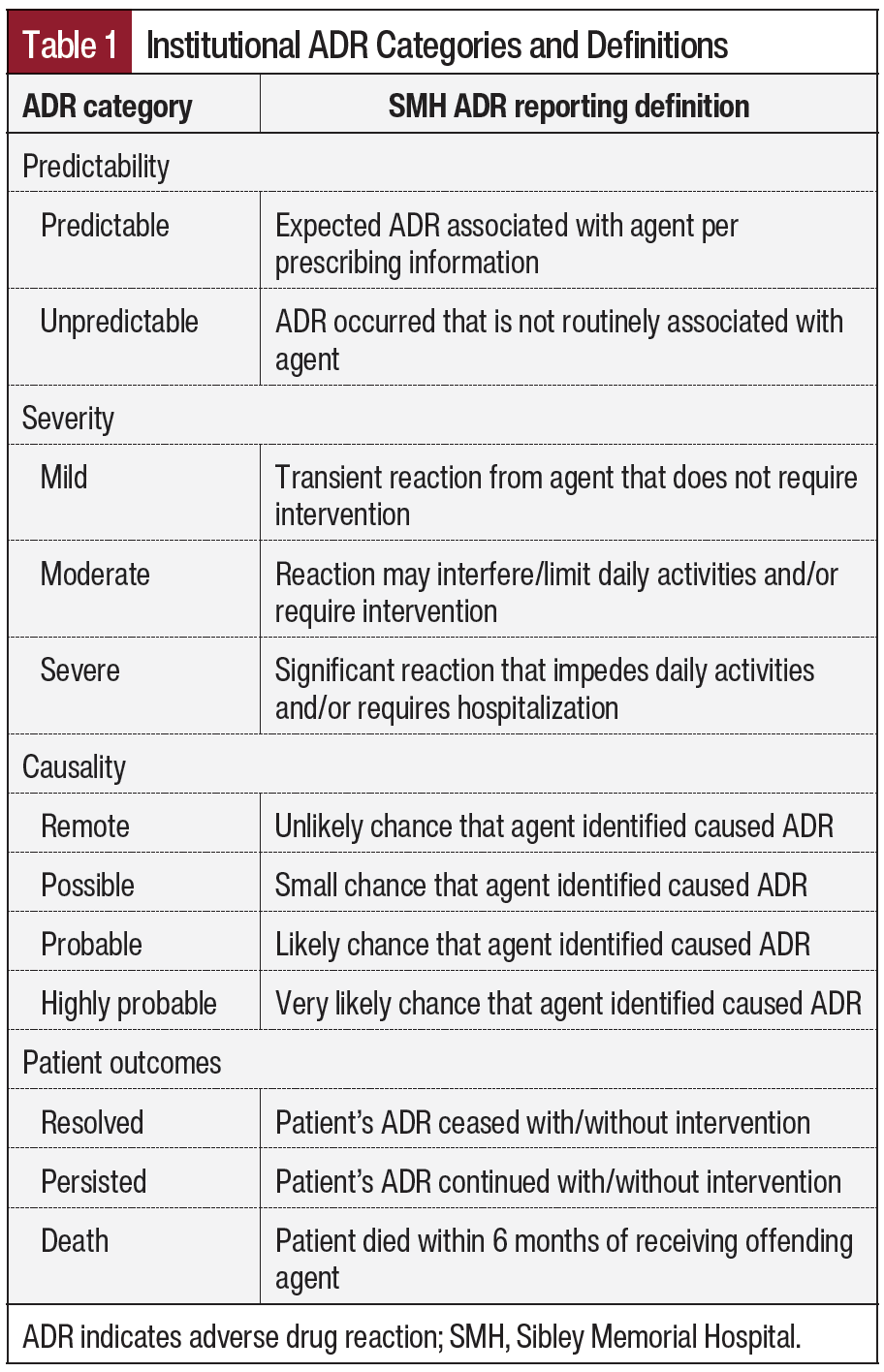
We assessed a representative sample of eligible patients for the extrapolation of annualized ADRs. This targeted approach sought to reach 20 confirmed ADR records. Per SMH’s institutional policies, these patient-level suspected ADRs were classified by predictability, severity, causality, and patient outcomes (Table 1).
The study inclusion criteria were age ≥18 years and being seen at the infusion center at SMH, having an order for chemotherapy and/or a biologic agent, and having a treatment modification in the chemotherapy treatment note between January 2020 and December 2020. The study’s exclusion criteria were receiving treatment somewhere other than SMH and not having treatment modifications made by oncologists at SMH.
Once the ADRs were categorized, the opportunities for improvement were identified via a stepwise approach. The first step was to review all antineoplastic ADRs captured via standard methods in SMH’s 2020 ADR Annual Report to assess the extent of missed or duplicate ADR reporting compared with the new approach via the EHR. The second step was to provide actionable recommendations to increase pharmacovigilance based on the research findings.
Results
A total of 331 treatment modification entries were collected from the EHR. Of these entries, 88 (26.6%) were reviewed to attain 20 confirmed and fully assessed ADRs. A total of 68 (77.3%) of the entries reviewed were categorized as non-ADRs, whereas 20 (22.7%) were categorized as confirmed ADRs (Table 2).

Of the 2 deaths that occurred, 1 resulted from ADRs associated with oxaliplatin treatment and 1 with afatinib treatment. In the oxaliplatin-related death, the patient initially received a dose of 85 mg/m2 for the salvage treatment of pancreatic cancer and had neuropathy. Neuropathy is a common (and sometimes irreversible) occurrence associated with oxaliplatin treatment that typically requires a dose reduction and/or dose discontinuation.6 For the management of the ADR, the dose of oxaliplatin was reduced to 65 mg/m2. Unfortunately, the cancer progressed rapidly, after which chemotherapy was stopped, and the patient transitioned to hospice and died shortly thereafter.
In the afatinib-related death, the patient initially received afatinib 30 mg for the treatment of lung cancer and had severe nausea. Although treatment with afatinib, an endothelial growth factor receptor inhibitor, has resulted in nausea, diarrhea is a more frequently associated ADR with afatinib.8 For the management of the ADR, the afatinib dose was reduced to 20 mg, and the patient was prescribed 2 antiemetic medications to take at home. The oncologist recommended holding chemotherapy, but after the patient expressed concern about the cancer progressing, the provider decided to continue treatment with afatinib. The patient died within 3 months of treatment initiation with afatinib. Oxaliplatin and afatinib were dosed according to their respective prescribing information.
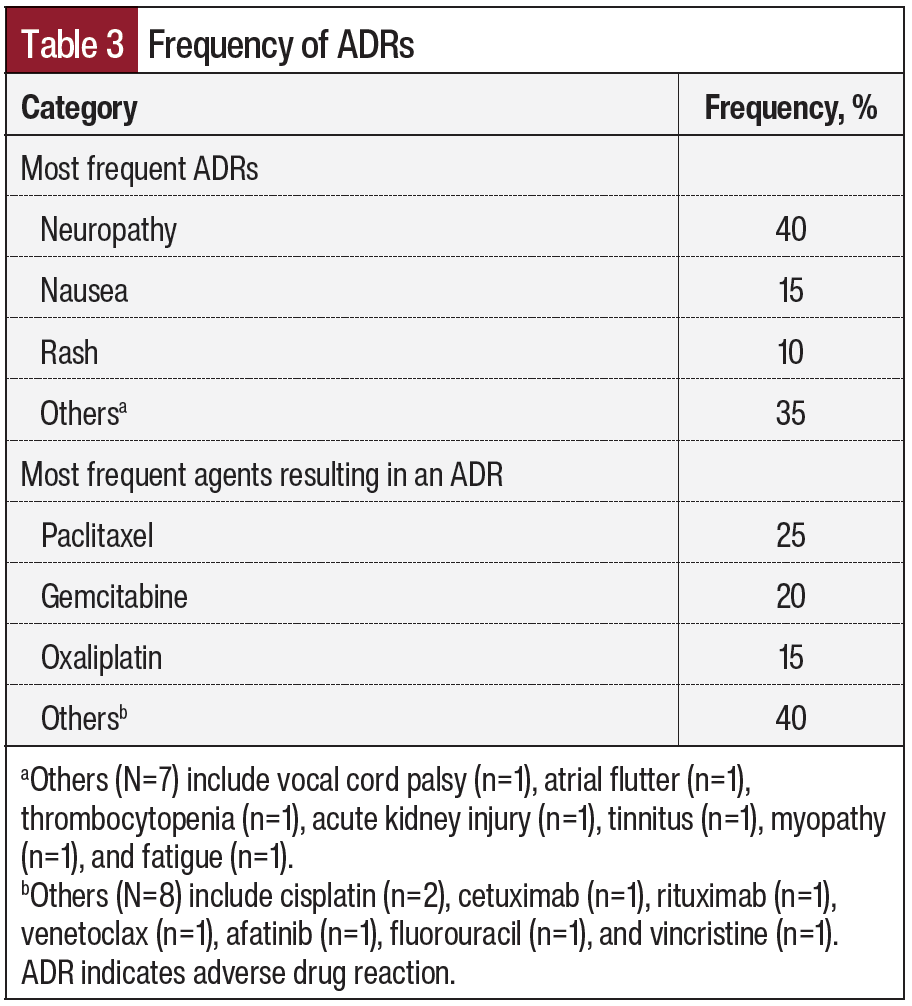
Neuropathy was the most frequent ADR identified in the total cohort (40%), followed by nausea (15%), rash (10%), and other reactions (35%; Table 3). Paclitaxel was the most frequent agent resulting in an ADR (25%), followed by gemcitabine (20%), oxaliplatin (15%), and other agents (40%). In terms of frequent relationships between ADRs and antineoplastic agents, paclitaxel was the most often associated with neuropathy. Other agents did not have frequent associations with the ADRs listed. None of the 20 ADRs that were identified were previously reported in the SMH 2020 ADR Annual Report. In other words, there was no overlap or duplication of ADR reporting. Comparing the 2 methods, the alternative method was able to capture ADRs that the institution’s conventional methods of reporting did not capture.
Discussion
Of the reviewed treatment note modifications entries, 25% were made by the oncology provider as a result of a suspected ADR. The review of 88 entries was required to reach 20 confirmed ADRs. Based on the study findings and the 331 total chemotherapy note modifications identified in 2020, it can be extrapolated that 75 previously unreported ADRs (approximately 25%) occurred in 2020 within the SMH infusion center, had all 331 modifications been reviewed by the research team. The patients identified in this study had a significant event from their chemotherapy regimens such that their treatment(s) required a dose reduction, delay, and/or discontinuation. These findings highlight the need for advancing current ADR reporting methods aided by EHR-facilitated quality improvement activities of the clinical pharmacy services to promote pharmacovigilance. Further research on the approach used at our infusion center should provide insight into the feasibility and generalizability of our findings to other high-volume oncology infusion center practices.
These findings highlight the need for advancing current ADR reporting methods aided by EHR-facilitated quality improvement activities of the clinical pharmacy services to promote pharmacovigilance.
Opportunities for Pharmacovigilance Improvement
Several opportunities for improvement have been identified through this research. These opportunities include reducing the time to fill out the SMH ADR antineoplastic form, improving clinical documentation in the treatment note modification, consistently documenting oncology drug allergies and intolerances in the EHR, and escalating ADR-related dose modifications to the proper institutional channels for reporting. The researchers who filled out the ADR form timed themselves from beginning to end and recorded the completion time in a spreadsheet. The average time for the completion of an ADR was 42 minutes. Recommendations to reduce the time to complete the form while providing a complete summary of the ADR include having online and paper versions, as well as having an open section for pertinent laboratory values rather than listing every laboratory value that is available.
Regarding improving clinical documentation, currently the rationale section of the treatment note is a free-text field that oncology providers are not required to fill out. The recommendations to improve this area include using keyword indicators described in the results section (eg, reduce, omit) to determine whether a suspected ADR has occurred. Using keyword indicators would allow for a more efficient capture of suspected ADRs.
For documenting allergies or intolerances, all 20 patients who had significant ADRs that resulted in a change to or a discontinuation of therapy did not have their reaction documented in the appropriate section of the EHR. The recommendations to improve this documentation include educating healthcare personnel (eg, nurses, oncologists, clinical pharmacists) on the use of documenting allergies and significant intolerances in the appropriate location.
Last, for institutional quality improvement reporting of ADRs via treatment note modifications, none of the 20 confirmed ADRs were reported via the standard methods. The researchers suspect that this is a result of the low level of reporting by infusion center staff and oncology providers combined with the high level of expected or predicted ADRs (95%) associated with those that were identified. For example, because oxaliplatin has a predictable adverse-event profile of resulting in neuropathy, providers may be less likely to further escalate the ADR to the proper channels and will simply choose to omit or reduce the dose in these settings. In addition, this method offers an automated yet highly clinical process to capture and analyze ADRs, which leads to improved pharmacovigilance. It is essential to leverage the expertise of the clinical pharmacists within the organization to efficiently capture and analyze ADRs in the infusion center’s patient population at SMH.
Conclusion
The alternative method used in this study to enhance pharmacovigilance in the oncology infusion center has been proven to capture ADRs that are not currently identified via standard quality improvement methods of reporting at SMH. Further analysis of the confirmed ADRs to identify educational and prevention measures should prove beneficial in improving the care of the patients, as well as in advancing the role of the clinical pharmacists.
The identified opportunities for improvement (including decreasing ADR form fill-out time, increasing provider modification documentation, increasing provider allergy or tolerance documentation, and escalating ADR-related modifications) will allow for this alternative method to improve pharmacovigilance for patients who receive care at the SMH infusion center. Similar to experiences at SMH, it is anticipated that an increasing number of oncology infusion center practices will adopt proactive, technology-aided pharmacovigilance approaches to improve patient care.
Further analysis of the confirmed ADRs to identify educational and prevention measures should prove beneficial in improving the care of the patients, as well as in advancing the role of the clinical pharmacists.
Acknowledgement
The researchers would like to acknowledge the Department of Pharmacy and the Department of Oncology at SMH for their assistance and support with the implementation of this study.
References
- Finn A, Bondarenka C, Edwards K, et al. Evaluation of electronic health record implementation on pharmacist interventions related to oral chemotherapy management. J Oncol Pharm Pract. 2017;23:563-574.
- Brockstein B, Hensing T, Carro GW, et al. Effect of an electronic health record on the culture of an outpatient medical oncology practice in a four-hospital integrated health care system: 5-year experience. J Oncol Pract. 2011;7e20-e24.
- Schiff GD, Klinger E, Salazar A, et al. Screening for adverse drug events: a randomized trial of automated calls coupled with phone-based pharmacists counseling. J Gen Intern Med. 2019;34:285-292.
- Salazar A, Amato MG, Shah SN, et al. Pharmacists’ role in detection and evaluation of adverse drug reactions: Developing proactive systems for pharmacosurveillance. Am J Health Syst Pharm. 2023;80:207-214.
- Di Maio M, Gallo C, Leighl NB, et al. Symptomatic toxicities experienced during anticancer treatment: agreement between patient and physician reporting in three randomized trials. Am J Clin Oncol. 2015;33:910-915.
- Hertz D, Dockter TJ, Satele DV, et al. Neuropathy severity at the time of oxaliplatin treatment alteration in patients with colon cancer (Alliance A151912). Support Care Cancer. 2021;29:7855-7863.
- Yokota H, Sato K, Sakamoto S, et al. Relationship between plasma concentrations of afatinib and the onset of diarrhea in patients with non-small cell lung cancer. Biology (Basel). 2021;10:1054.